Snake Removal Asheville NC | Safe Snake Removal in Western North Carolina | WNC Wildlife Removal
Asheville & Western North Carolina

Snake Removal
Done Right

Safe identification, removal, and exclusion for copperheads, timber rattlesnakes, rat snakes, and every other species found in WNC homes and properties.

828-215-4712
Quick Answer

If you've found a snake in your home or on your property and want it gone safely, call 828-215-4712. We'll identify the species, remove it humanely, and show you how it got in so it doesn't happen again.

Snakes You'll Actually See in WNC

North Carolina is home to 37 species of snakes. Only six are venomous. And here in the mountains, that number drops to two: the copperhead and the timber rattlesnake.

Most calls we get turn out to be harmless species. Black rat snakes are the most common. They're big, sometimes over five feet, and they're excellent climbers. If a snake followed a mouse trail into your attic, there's a good chance it's a rat snake.

The northern water snake is the other one that causes panic. People see them along creeks and rivers in Buncombe, Henderson, and Transylvania counties and assume they're cottonmouths. They're not. There are no cottonmouths in the WNC mountains. Period.

🔍
What Most People Miss

You can't reliably identify a venomous snake by its head shape. Many non-venomous species flatten their heads into a triangle shape when they feel threatened. The NC Wildlife Resources Commission specifically warns against using head shape as an identification method. If you're not sure what you're looking at, don't get closer to find out. Call a professional.

Venomous

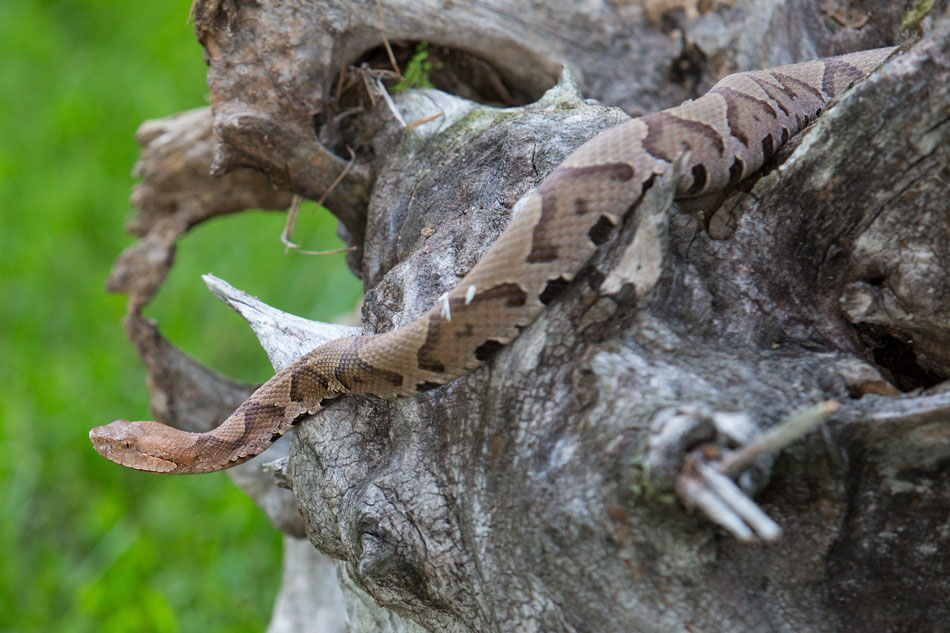
Copperhead

The most commonly encountered venomous snake in WNC. Found in suburban yards, woodpiles, and leaf litter. Identified by distinctive hourglass or "Hershey's Kiss" pattern. Most active on warm summer evenings. Bites are painful but rarely fatal when treated promptly.

Venomous

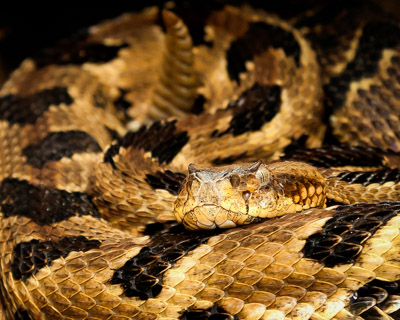
Timber Rattlesnake

Found on rocky slopes and ridgelines, mostly at higher elevations. Gray, brown, and black coloring that blends with mountain terrain. Protected under the NC Endangered Species Act. We do not harm or relocate these without proper authorization. Typically avoids developed areas.

Non-venomous

Black Rat Snake

The most common large snake in WNC homes. Excellent climbers that follow rodent scent trails up walls, brick mortar lines, and gutter spouts. Often found in attics and crawl spaces. Can reach six feet. Startling but completely harmless to people.

Non-venomous

Northern Water Snake

The most misidentified snake in the mountains. Found along every creek and river in WNC. Can grow to five feet with brown banding that people mistake for a cottonmouth. Irritable if approached but not dangerous. Commonly seen in Pisgah National Forest waterways.

Non-venomous

Garter & Milk Snakes

Small, common yard snakes. Garter snakes eat insects and frogs. Milk snakes have reddish banding that sometimes gets them confused with copperheads. Both are harmless and rarely exceed two to three feet. Frequently found under rocks, mulch, and garden debris.

Non-venomous

Ring-necked & Brown Snakes

Tiny snakes, usually six to twelve inches, that live under rocks, logs, and garage clutter. Ring-necked snakes have a distinctive yellow or orange collar. You'll most often find them when moving firewood or turning over landscaping stones. Completely harmless.

Snake in your home? We can help. 828-215-4712

How Snakes Get Inside WNC Homes

Snakes don't break in. They walk through the front door, so to speak. Every snake inside a home got there through an existing opening, and almost always because something else got there first.

The pattern we see most often in the Asheville area works like this. Mice find a gap in your foundation, crawl space vent, or roofline. They set up a nest. Their body oils leave scent trails along every path they use. A rat snake or other species picks up that scent and follows the same trail, through the same gap, right into your home.

That's why a snake in your house is almost always a sign of a second problem. If you've got snakes, you've probably got rodents too.

Pro Tip

Black rat snakes in WNC will climb brick mortar lines, gutter downspouts, and tree branches overlapping your roofline to reach attic-level entry points. If your snake problem seems like it's "up high," check for rodent activity in the attic. The snake is following the food.

Common Entry Points We Find

Foundation cracks and gaps. Any opening wider than a quarter-inch is big enough for most snakes. Older homes in Montford, West Asheville, and Hendersonville often have settling cracks that go unnoticed for years.
Damaged crawl space vents. Rusted or broken vent screens are the number one entry point for snakes in WNC homes with crawl spaces. And that's most homes in the mountains.
Plumbing and utility penetrations. Where pipes, wires, and HVAC lines enter your home, there are often gaps. Builders don't always seal these as tightly as you'd think.
Roofline gaps and soffit openings. Rat snakes climb. If a squirrel or mouse has chewed an opening along your roofline, a snake will use it. We see this constantly on homes backed up to wooded lots in Black Mountain, Fairview, and Arden.
Garage door seals. Worn-out weather stripping at the bottom of a garage door is an open invitation. Snakes will move into garages for warmth, shelter, and access to rodents.

How We Handle Snake Removal

We don't just grab the snake and leave. Every snake in a home got there for a reason, and if you don't address that reason, you'll be calling again in a few weeks.

1

Identification

We identify the species on-site. If it's a venomous copperhead, that changes how we handle it. If it's a black rat snake, we know to look for rodent activity. The species tells us the story.

2

Safe Removal

We capture and remove the snake using professional tools. Venomous and non-venomous species are handled differently. All snakes are removed humanely and relocated a short distance from the capture site, which gives them the best chance of survival.

3

Entry Point Inspection

We inspect your home's exterior and interior for every gap, crack, and opening that could allow snakes or their prey to enter. We check foundation lines, crawl space vents, rooflines, utility penetrations, and garage door seals.

4

Exclusion & Prevention

We seal entry points using materials rated to keep wildlife out. If we find signs of rodent activity, we'll let you know, because solving the snake problem means solving the rodent problem. One without the other is a temporary fix.

5

Written Report

You get a written summary of what we found, what we did, and what you should keep an eye on. No guesswork, no verbal-only handshake. Everything documented.

🛑
Safety Warning

If you find a snake in your home and you're not 100% certain it's non-venomous, treat it as if it's venomous. Don't try to kill it, trap it, or move it yourself. Close the door to the room, put a rolled towel under the gap, and call us. North Carolina leads the country in snakebite incidents per capita, and most bites happen when someone is trying to handle or kill a snake.

Don't wait. We respond fast. 828-215-4712

When Snakes Are Active in WNC

Snake activity in Western North Carolina follows a predictable cycle. Calls pick up in April as temperatures climb, peak in June through August, and taper off in October as nights get cold. But in the milder WNC climate, we get occasional calls even in winter, especially from homes with warm crawl spaces.

Copperheads are most active on warm summer evenings. If you're finding a copperhead in your yard, it's almost always between dusk and dawn during June, July, or August.

🌦
Seasonal Note

September and October in WNC bring a second wave of snake calls. As temperatures drop, snakes look for warm, sheltered spots to overwinter. Crawl spaces, basements, and garages become prime targets. If you're going to do exclusion work, late summer is the time to get it done.

JanFebMarAprMayJunJulAugSepOctNovDec
Copperhead
Rat Snake
Timber Rattlesnake
Garter/Milk Snake

High Activity Moderate Low Dormant

Snake Regulations in North Carolina

North Carolina takes snake protection seriously. Nine species are listed as threatened, endangered, or of special concern at the state or federal level. That includes the timber rattlesnake, which we do encounter in WNC.

All three rattlesnake species native to North Carolina, plus the eastern coral snake, are protected under the NC Endangered Species Act. It is illegal to kill, harm, harass, or relocate these species without an Endangered Species Permit from the NC Wildlife Resources Commission.

NC Regulations

Killing a protected snake species in North Carolina is a Class 2 misdemeanor. Protected species include timber rattlesnakes, eastern diamondback rattlesnakes, Carolina pygmy rattlesnakes, eastern coral snakes, northern pine snakes, Carolina watersnakes, Outer Banks kingsnakes, smooth green snakes, and southern hognose snakes. Even if the snake is on your property, the law applies. Call a licensed professional.

For non-protected species, relocation is allowed on private property with the landowner's permission. But here's something most people don't know: research shows that most snake species die from stress if relocated more than two miles from the capture site. That's why we always relocate short distances, close to where the snake was found, just away from the home.

🔍
What Most People Miss

Snake repellents don't work. The NC Wildlife Resources Commission has stated plainly that no commercially available snake repellent products are proven to be effective. Sulfur, mothballs, essential oils, chemical sprays: none of them work. The only thing that actually keeps snakes out of your home is physical exclusion, sealing every gap and opening they could use.

Snake Removal vs. Snake Trapping

These are two different services, and which one you need depends on your situation.

Snake removal is what you need when you can see the snake or know where it is. We come out, identify the species, capture it, and relocate it. It's typically a same-day visit. If you've got a black rat snake in your kitchen or a copperhead under your front steps, this is what you're looking for.

Snake trapping is for situations where you've seen evidence of snake activity but can't locate the snake itself. Maybe you found a shed skin in the crawl space, or you've seen a snake twice this week but it disappears before you can get a good look. Trapping involves placing specialized traps in areas of known activity and checking them over several days.

Both services include an inspection of entry points and a recommendation for exclusion work. Because again, if you're not addressing how the snake got in, you're not solving the problem.

Pro Tip

If you call about a snake you saw last week and it's not there anymore, that's a trapping situation, not a removal situation. Searching for a snake that was spotted days ago is like looking for a needle in a haystack. Traps are far more effective than a one-time search when the snake has had time to move.

💰
Cost

Snake removal pricing depends on the situation. A straightforward removal of a visible snake is different from a multi-visit exclusion project. We provide written estimates before any work begins, and we'll give you a price range over the phone when you describe what's going on. No surprises. Call 828-215-4712 for a quote.

Keeping Snakes Away From Your Home

You can't make your property completely snake-proof if you live near woods, creeks, or undeveloped land in WNC. And honestly, snakes passing through your yard isn't a problem. They eat rodents, and that's a service you're getting for free.

But you can make your home a lot less attractive to snakes. And the approach is the same one that works for almost every wildlife issue: remove shelter, remove food sources, and seal entry points.

Remove ground-level shelter. Woodpiles, scrap metal, boards, dense ground cover, and landscape debris all give snakes a place to hide. Move firewood away from the foundation. Keep vegetation trimmed close to the house.

Address rodent problems. If mice or rats are getting into your home, snakes will follow. The rodents leave scent trails that snakes track like a highway. Solving the rodent problem is the most effective thing you can do to prevent snakes.

Seal entry points. This is the big one. Every gap wider than a quarter-inch is a potential entry point. Crawl space vents, foundation cracks, utility penetrations, roofline gaps, and garage door seals are the most common problem areas in WNC homes.

Trim trees and shrubs away from the house. Black rat snakes are strong climbers. If branches touch or overhang your roof, that's a bridge to your attic. Keep a clear gap between vegetation and the roofline.

🕒
Best Time

The best time for snake exclusion work in WNC is late winter through early spring, before snake activity picks up. If you wait until June, you risk sealing a snake inside. We schedule exclusion work year-round, but getting ahead of the active season makes the most sense.

Ready for an inspection? 828-215-4712

Common Questions About Snake Removal

Western North Carolina is home to two venomous snake species: the copperhead and the timber rattlesnake. Copperheads are by far the most common and are found throughout the region, including in suburban neighborhoods. Timber rattlesnakes tend to stay on rocky slopes and ridgelines at higher elevations.

Despite what many people believe, there are no cottonmouths or water moccasins in the WNC mountains. The large water snakes you see along creeks and rivers here are northern water snakes. They look similar but are completely non-venomous.

Yes, several species are protected. Timber rattlesnakes, eastern diamondback rattlesnakes, Carolina pygmy rattlesnakes, eastern coral snakes, northern pine snakes, Carolina watersnakes, Outer Banks kingsnakes, smooth green snakes, and southern hognose snakes are all protected under NC law. Killing a protected species can result in a Class 2 misdemeanor charge, fines, and potential jail time.

Even for non-protected species, professional removal and relocation is always the better option. And since most people can't reliably tell venomous from non-venomous in the moment, handling the situation yourself carries real risk.

Snakes follow scent trails left by rodents, birds, and other animals that are already using your home for shelter. They enter through foundation cracks, gaps around plumbing and utility penetrations, damaged crawl space vents, and openings in the roofline.

In WNC, black rat snakes are especially good climbers and will follow rodent trails up brick mortar lines and gutter downspouts to reach attic-level entry points. If you've found a snake in your attic, there's almost certainly a rodent problem you didn't know about.

Keep your distance. Don't try to handle or kill the snake. If you can, close the door to the room and place a rolled towel under the gap to keep the snake contained. Then call us at 828-215-4712.

If you can safely take a photo from a distance, that helps with identification before we arrive. But don't get close enough to check the snake's head shape or eye pupils. That's how bites happen.

Pricing depends on the situation. A straightforward removal of a visible snake is typically less than a multi-visit exclusion project. We provide written estimates before any work begins. Call 828-215-4712 and describe your situation. We'll give you a price range over the phone.

No. The NC Wildlife Resources Commission has stated that no commercially available snake repellent products are proven effective. Sulfur, mothballs, essential oils, and chemical sprays have all been tested and none of them work reliably.

The only reliable method is physical exclusion: sealing every gap and entry point a snake could use to enter your home. Anything else is money wasted.

Activity peaks from April through October, with the busiest months being May through September. Copperheads are most active on warm evenings and at night during summer. In the milder WNC climate, some activity can occur year-round during warm spells, especially in crawl spaces and other sheltered areas that stay above freezing.

Snake removal is the physical capture and relocation of a snake that has been located in or around your home. It's typically a same-day service.

Snake trapping involves placing specially designed traps in areas of known snake activity and checking them over a period of days or weeks. Trapping is used when snakes have been seen but can't be located, or when there's evidence of ongoing activity in a crawl space, attic, or other hard-to-access area. Learn more about our snake trapping service.

828-215-4712

WNC Wildlife Removal • Asheville & Western North Carolina

Licensed • Insured • Humane Wildlife Removal & Exclusion

© 2026 WNC Wildlife Removal. All rights reserved.